

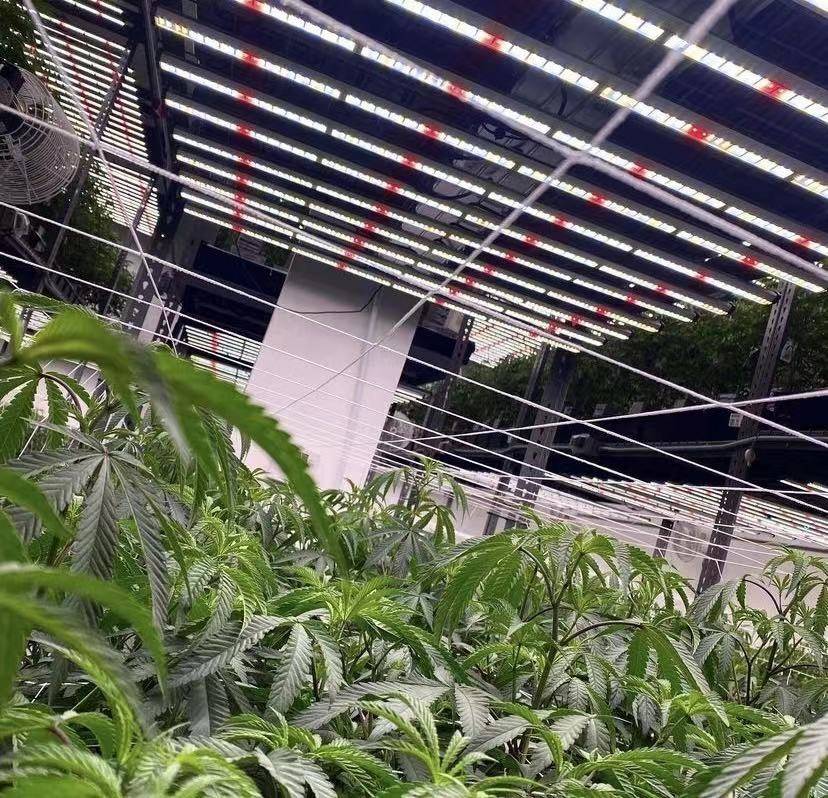
There are many things to consider when purchasing LED grow lights . The coverage area and light distance will help narrow down your search results and ensure your grow space is appropriately covered. PAR output is measured in different ways and misinformation about intensity is very common. The light spectrum that the LED grows light emits is important since cannabis has different needs throughout its life. Also, an even light spread will help with growth across the entire plant. Wattage is often confused for light intensity instead of what it actually is – energy consumption. It’s better to go with high-quality diodes and efficient drivers from trusted manufacturers instead of going with unknown brands. Lastly, the warranty that the LED grows light has will offer you protection in case the light becomes defective. Considering these things prior to buying a LED grow light will help ensure your money is being well-spent.
1.Coverage Area & Light DistanceFirst of all, you need to know the size of the grow space that your plants will be growing in. Measure your grow space – length, width, and height. Knowing what size grow area you will be growing in is arguably the most important piece of information to know when shopping for LED grow lights . A LED grows light manufacturer will design their grow light for a specific coverage area. The most common coverage areas are 2’x2’, 2’x4’, 3’x3’, 4’x4’, and 5’x5’. As you can see, the length and width are mentioned, but not the height. Hang tight. We will talk about the height of your grow space in a minute. Once you measure your grow space and know what area you need your LED grow light to cover, you can narrow down your search results by filtering to show LED grow lights specific to your grow space.
Now, what about the height of your grow space? That comes into play when we talk about light distance. Every grows light listing should state the coverage area as well as the recommended light distance. The light distance is the distance between the grow light and the top of your plants. Light distance is another thing you need to consider when buying a LED grow light. I’ve had several growers contact me asking for advice on plants that grew too close to their grow light – because they did not factor in the light distance when buying their LED grow light. Let’s go over a quick example. Say your grow space is 4’x4’x6’ (L x W x H) and the recommended light distance on your LED grow light is 24”. So, 6’ (height of grow space) minus 2’ (light distance) equals 4’ tall plants? Right? Wrong! You should also consider the grow pot (which often takes up about 12” depending on the grow pot size) and the “lost distance” above the grow lights which is taken up by the grow light hanging kit.
2.Wattage
This is the most common measure of grow light intensity and is a measure of electricity (watt = amp x volt). This measure can be misleading, though. Some manufacturers (the better ones) give the actual wattage the unit uses – the wall plug wattage. Others, typically lesser brands, will give you the max wattage rating of the LED diodes. To use a simple example, a grow light could call itself 90 watts if it has thirty 3 watt LED’s, however, it is common practice to run LED’s at half wattage to reduce heat production (and therefore heatsink cost) and increase efficiency. So, what was called a 90w grow light could really be 45w (or less!).
Bottom line, you want an actual power draw, not an LED wattage rating. It can be good to be suspicious of overly round numbers – you are likely getting the diode rating and not the actual power draw. Knowing the wattage of the diodes isn’t useless, though. You will get a heck of a lot more light out of a 3-watt diode run at 1 watt than a 1-watt diode run at 1 watt.
3.PPF
PPF (Photosynthetic Photon Flux) measures the total amount of light produced by a grow light in terms of micromoles of photons produced per second (often written as umol/s or μmol/s). This is an important number because unlike PPFD (which will be explained below) it can’t be manipulated and tells you the full amount of light coming from the LED grow lights .
4.PPFD
PPFD (Photosynthetic Photon Flux Density) measures the number of micromoles of photons striking a square meter per second (often written as umol/m2/s, μmol/m2/s, or μmolm-2s-1).
Full daylight sun at noon in the summer is around 2000 μmol/m2/s. What your plants actually need, however, is likely to be much less than that. In fact, because the Sun’s intensity is only that bright for a small portion of the day and because the angle of that intensity changes throughout the day, providing that much light for an extended period of time would very likely be damaging to your plant. A ‘light response curve’ shows how effectively a plant utilizes light at differing intensities. Depending on the plant, at levels greater than 800-1000 μmol/m2/s the efficiency that a plant uses the light starts to slow. Meaning, you can provide your plant more light than this, but you might not see a huge change in outcome.
It’s worth noting that some LED companies can increase their PPFD numbers by measuring extremely close to the grow light or using spot-light like reflectors or lenses. An LED company should always report what distance their PPFD numbers were taken at (e.g., 24 in, etc.).
5.PAR
This is not a measurement at all, but instead, a type of light that can be absorbed by plants (and coincidentally seen by humans). It ranges from 400 to 700nm.
6.Lumens
This is a measure of the total apparent brightness of a light source and not how many photons are produced. As the cliche goes, “lumens are for humans.” You can think of it as the brightness of a single candle (although the real definition is more complex). By in large, lumens are not a useful measure of light intensity for plants since they overweight colors like green and underweight reds and blues. For instance, 1W of radiant flux at 550nm (green, which the human eye is very sensitive to) is 675 lumens. One watt of radiant flux at 660nm (deep red) is only 45 lumens. The red light will be more easily absorbed by your plant in photosynthesis than the green one, but your eye will see the green light as 15 times brighter than the red light!
7.Lux/Footcandle
This measures how much brightness is striking a unit of area. Contrast this with lumen which is the total amount of brightness coming from the light source in all directions. Lux = one lumen per meter squared. Footcandle = one lumen per foot squared.
Seedlings, clones, mother plants: 200-400 PPFD
Early to late Veg: 400-600 PPFD
Flowering: 600-900 PPFD
Some of you may be wondering about the LED grow lights that produce over 900 PPFD. Will a PPFD higher than 900 produce bigger buds on your plant? The answer to that is yes - only if you run a high CO2 in your grow environment. CO2 is measured by PPM and the CO2 level outside is 400-500 PPM. Plants grow just fine with that amount of CO2. Some advanced growers will add CO2 into their grow room to get the CO2 PPM in the range of 1,000-1,500. Running a higher CO2 PPM like that will allow your plant to absorb more PAR. On the flip side, if you are not supplementing with CO2 and provide your plant with too much PAR, then your plant could encounter problems.
8.Diodes
The diodes on a grow light can certainly have a large impact on the fixture’s performance. The process to create and sort diodes is actually pretty interesting. Each diode made in a given production run will exhibit tiny variances from the others in its batch, despite the fact that they were all created with the same materials. For this reason, manufacturers sort newly created diodes through a classification process that groups together like diodes. This process is called binning. The criteria manufacturers use to bin their diodes are color wavelength and forward voltage. These two metrics measure the specific color profile and brightness levels of a given diode. Each diode manufacturer has its own binning process and “Top Bin” diodes are the best diodes out of the batch produced. The best diode manufacturers here in 2021 are CREE, OSRAM, and Samsung. Many growers will only buy LED grow light with diodes from those manufacturers since they are well-known for their exceptional quality.


